Tuesday, July 24, 2012

City Park Campus Map

Prepared by Valerie Mesa-Vega

Here is a map of the City Park campus which attempts to list the location of important student services by building.

In the library, we get hundreds of questions each month about where to register, or go for advising, or testing, or financial aid, etc.

This map has helped us in responding to and addressing students' needs. Hopefully it can help you too.


Friday, July 13, 2012

Reference Inventory Underway

Electrical wire to power the laptop


The library at City Park has been operating since 2007 with the vast majority of its print collection stored in trailers on the other side of campus. The Reference Room in Building 10 provides access to about 4,500 reference items--dictionaries, encyclopedias, handbooks, guides, and almanacs on all topics. With succinct yet comprehensive essays on all topics written by specialists, usually ranging in length from 1-7 pages, these truly are the best place to start one's research. But in addition to the 4,500 volumes readily accessible in the Reference Room, we also have about 10,000 more Reference items in storage.

One of two Reference storage trailers
Because we are in many ways still getting the collection back into order since Hurricane Katrina (the old library was destroyed after the storm and we are still waiting for a new library to replace it), we decided to undertake an inventory of the Reference collection this summer in the hopes of refining our holdings. The first part of the process has been to scan every item, one by one. First we did the Reference Room (appx. 4,500 volumes), then we moved on to the trailers. Just yesterday, we had the honor of scanning item number 4,000 in the first of two reference storage trailers.
The 4,000th item being scanned
The inventory work station in the trailer


Friday the 13th


Prepared by Jaleesa DeLavallade


Are you a superstitious person? Do you believe four leaf clovers or knocking on wood will bring good luck? Will breaking a mirror, walking under a ladder, or black cats crossing your path bring bad luck? The list of superstitions can go on and on. Some people are also superstitious about their dreams at night and they believe that they can be interpreted. If you do a subject search in Delgado’s catalog for dream interpretation there will be several interesting titles in the results.

Well, for those of you who are superstitious, today is the third and final Friday the 13th of the year. To make things extra creepy, each Friday the 13th this year was 13 weeks apart. 

It is not exactly known why Friday the 13th is considered unlucky. Some background information on superstitions in general is available from from the Gale Virtual Reference Library. The "superstitions" entry in The Gale Encyclopedia of the Unusual and Unexplained is informative. The About.com Urban Legends page gives additional background information. 

It doesn’t help that the year is 2012 and some people believe that the world will end according to the Mayan Calendar. 

Good luck today!


Some resources at Delgado:


Monday, July 9, 2012

Recycling at Delgado Community College


 Prepared by Valerie Mesa-Vega

 BACKGROUND

Have you noticed any blue bins around campus lately? There are currently 11 blue bins around Delgado, including the library at City Park. The bins are part of the Delgado Recycling initiative. 

Since the Fall 2011 semester, the Delgado Faculty Senate and the SGA have been working together to bring a recycling program to Delgado. At a September 2011 Faculty Senate meeting, a discussion was held about starting a recycling program at Delgado. By November 2011, the SGA got involved and a meeting was held to brainstorm ideas for the recycling program. 

Members of the Recycling Committee also had the opportunity to tour the Allied Waste facility, the company in charge of picking up the recycling. In the meantime, the City Park library had created its own small recycling initiative, accepting only paper materials. Finally in April 2012, just in time for Earth Day, the Recycling Committee launched Delgado’s Recycling initiative. Blue bins have been placed around campus, including the libraries at City Park and East Jefferson, for recyclable materials. 

What can you recycle in the blue bins?
  • Paper
  • Plastic
  • Cans (aluminum and tin)
According to Marion Freistadt, member of the recycling committee, the goal envisioned is to have full recycling across all of Delgado’s campuses. She also stated Coca Cola has donated 50 bins for recycling that need to be cleaned and moved. More green initiatives are also envisioned for the future, but for now, the recycling bins are a step in the right direction at Delgado to reduce waste and to save resources. Instead of tossing that plastic drink bottle or can into the trash, find a blue recycling bin and place it there.

RESOURCES
 
Some Books on Recycling at the Delgado Library:

Thursday, July 5, 2012

Recharge at the Library

Prepared by Shawn Christy

Need more power? 

Patrons in need of a recharge for their mobile electronics will be pleased to note the locations of AC power outlets throughout City Park’s main library. 

The map posted here shows all power outlets, which will vary in accessibility, so please be considerate of others when plugging in. 

Friday, June 22, 2012

Pencil Sharpening is Not a Joke

Last year at this time, the Library Circulation desk was briefly without an adequately functioning pencil sharpener. An electric sharpener had just stopped working, while another, older one was still in a drawer, broken. But with students constantly looking to sharpen their pencils, we quickly discovered that the demand for pencil sharpening in the Library at Delgado is simply too great to ignore.

The pencil sharpener at  the City Park Library
We immediately made moves to acquire and install a new, manual sharpener on the side of the circulation desk, next to a pile of scrap paper we like to keep handy. Additional pocket sharpeners were also acquired and left in desk drawers at all public service points, in case of an emergency. Luckily, these acquisitions were made just before the Library budget was frozen last year, whence it could have been too late to meet this recurring need of our patrons.


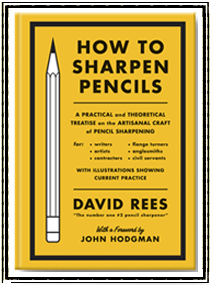
The recent publication and warm reception of the book How to Sharpen Pencils: A Practical and Theoretical Treatise on the Artisanal Craft of Pencil Sharpening is a reminder of how important pencil sharpening is in fact, both at Delgado and probably everywhere. It is exciting to see something so basic receiving such careful attention. The book's author, David Rees, keeps the Artisanal Pencil Sharpening website. Reviews of his new book have been published in such publications as The New Yorker and BusinessWeek.

Pencil shavings at the City Park Library
Delgado Library Circulation staff person Valerie Mesa-Vega reports that the manual sharpener is used often and needs to be emptied at least once per week. She also likes to point out that the manual sharpener is not friendly to left-handed individuals, who may find it difficult to coordinate the sharpener crank with their "wrong" hand.

A keyword search in the Library Catalog for "pencil" finds nearly 100 items. Some dealing with pencil drawing techniques, others dealing with world trade and manufacturing data pertaining to pencils, and one containing "letters, essays, cartoons, and commentary on how and why to live contraption free in a computer-crazed world" (see book here).


All of this is a welcome reminder, especially at a place like Delgado Community College - whose motto is "education that works" - that the economy is open to craft, creativity, and industriousness.

City Park Library Circulation Desk with Valerie Mesa-Vega. The pencil sharpener is on the far side by the windows.


Thursday, June 21, 2012

Oxford English Dictionary : Word of the Day

Did you know that you can subscribe to the Oxford English Dictionary (OED) “Word of the Day” by email?  This is a great way to learn new words and their histories.

  1. Follow the OED link above
  2. Click Sign up for word of the day, as pictured below
  3. And voila! You'll get a new word each day in your email


What makes the OED a go-to reference for scholars in all disciplines is that it is a descriptive dictionary, and not a prescriptive one. That means it tells us the history of the use of a word over time, and not necessarily how we should use the word. Check it out, scholars make reference to it all the time in their work.


Whenever you're writing about any topic, it's always a good idea to define some of your key terms. And it's always interesting to tell your readers something about how others may have used a given term or topic in the past. Give it a try! It's also an easy way to get another page or two out of any paper. Just pick a key concept, see what it says about it in the OED, and give your readers some context.


If you like the OED, check out some of the Library's other Oxford resources. Some of them are listed on the Title List of databases under the letter O.